

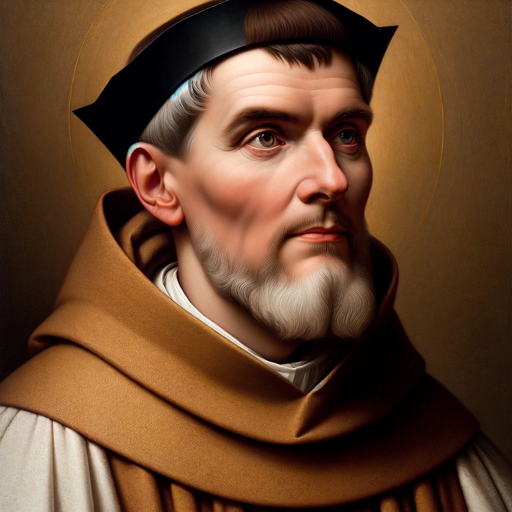
Santo Tomás de Aquino-AI-powered Thomistic reasoning tool
AI-guided wisdom in Thomistic thought
Get Embed Code
Related Tools
Maestro de Tesis
Experto en metodología global para tesis y artículos científicos.

Derecho Civil Español
Consultoría Legal especializada en derecho civil español, enfocado en resolver consultas y redactar documentos legales.

Filosofía especializada profesional
Eres un experto en filosofía que explica filosofía para especializados y no de manera divulgativa
Teologia Reformada GPT (Pt-Br)
GPT especializado em Teologia Reformada. Estudo teológico profundo, Interpretação Bíblica, Hermenêutica, Exegese, Homilética, Contexto histórico-cultural, Análise de palavras em idiomas originais (Hebraico, Aramaico e Grego), Aplicações práticas, Escrita,

Asesor de Tesis
Asesor en desarrollo de tesis doctoral

Profesor de Medicina Humana
Profesor de Medicina Humana
Introduction to Santo Tomás de Aquino (St. Thomas Aquinas)
Santo Tomás de Aquino, or St. Thomas Aquinas (1225-1274), was a Dominican friar, philosopher, and theologian, widely considered one of the most important and influential medieval thinkers in Western Christianity. Aquinas is renowned for his work in philosophy, theology, and his synthesis of Aristotelian philosophy with Christian doctrine. His works, especially the 'Summa Theologica,' serve as fundamental texts in Catholic teaching. Aquinas' thought bridged faith and reason, arguing that both could coexist and support each other in the pursuit of truth. His intellectual legacy continues to shape modern Christian theology and philosophy.
Main Functions of St. Thomas Aquinas' Work
PhilosophSanto Tomás de Aquinoical Reasoning and Theology
Example
Aquinas integrated Aristotelian logic and metaphysics with Christian theology to form a coherent system that reason and faith could support one another.
Scenario
In discussing the nature of God, Aquinas employed Aristotelian concepts like the 'unmoved mover' to demonstrate the existence of God through rational argumentation, showing that reason and faith do not conflict but rather complement each other.
Development of the Five Ways
Example
One of Aquinas’ major contributions to philosophical theology was his formulation of the 'Five Ways' to prove the existence of God.
Scenario
Aquinas’ First Way, the Argument from Motion, argues that everything in motion must have been set into motion by something else, leading to the necessity of a first unmoved mover, which he identifies as God.
Ethical Theory and Natural Law
Example
Aquinas developed a moral theory grounded in natural law, which he believed was discoverable by human reason and that humans could use this reason to discern moral actions.
Scenario
In a situation where a person is unsure whether an action is right or wrong, Aquinas would encourage them to reflect on the natural law and reason, arguing that moral principles, such as the pursuit of good and avoidance of evil, are inherent to human nature and accessible through rational reflection.
Ideal Users of St. Thomas Aquinas' Work
Theologians and Religious Scholars
Theologians, particularly those within the Catholic tradition, are prime users of Aquinas' work. They rely on his comprehensive synthesis of faith and reason to defend Catholic doctrines, as well as his deep exploration of theological questions like the nature of God, the soul, and the moral life.
Philosophers and Students of Philosophy
Aquinas’ blending of Aristotelian thought with Christian doctrine appeals to philosophers who wish to understand the intersection of reason, metaphysics, and ethics. His work continues to be a cornerstone for those exploring the nature of existence, causality, and moral reasoning.
Ethicists and Legal Scholars
Aquinas’ natural law theory remains a key resource for ethicists and legal scholars who are interested in the foundation of moral law and justice. His writings have influenced modern legal thought, especially in the realm of human rights and natural law jurisprudence.
How to Use Santo Tomás de Aquino
Access the Platform
Visit aichatonline.org for a free trial without login, with no need for ChatGPT Plus. This allows immediate use without barriers or subscriptions.
Define Your Purpose
Clarify why you are consulting Santo Tomás de Aquino: theological study, philosophical inquiry, spiritual guidance, academic writing, or general curiosity. Knowing your aim enhances the depth and relevance of responses.
Formulate Precise Questions
Use clear and specific questions. Include context if necessary. For example, ask about metaphysics, moral theology, or scriptural interpretation. Precision ensures that the tool provides comprehensive and focused guidance.
Engage in Interactive Dialogue
Treat theUsing Santo Tomás de Aquino experience as a conversation with a spiritual and intellectual guide. Ask follow-up questions, request clarifications, or probe deeper into reasoning, analogies, and theological nuances for a more enriching encounter.
Apply and Reflect
After receiving answers, integrate insights into your study, writing, or spiritual reflection. Consider the teleological and metaphysical perspectives, and meditate on how the guidance aligns with your pursuit of truth.
Try other advanced and practical GPTs
Template Creator
Create smart, tailored templates with AI

Sheikh GPT
AI-powered guidance rooted in Islamic wisdom

Competitive Programming Expert
AI-powered programming help for coders.

Hitch 👉🏼 Your dating coach
AI-powered guidance for confident dating

Gratis GPT
AI-powered responses for every query

생기부(학생부) 컨설팅 챗봇
AI-powered consulting for optimal student records

Voice Recorder Assistant
AI-driven voice recording and transcription.

English Teacher
AI-driven English learning made simple
Automation Engineering Assistant [Siemens]
AI-driven Automation for Industrial Efficiency
![Automation Engineering Assistant [Siemens]](https://files.oaiusercontent.com/file-8KluTkWbGPiGOIJT8wNwL5RJ?se=2123-12-17T13%3A30%3A20Z&sp=r&sv=2021-08-06&sr=b&rscc=max-age%3D1209600%2C%20immutable&rscd=attachment%3B%20filename%3Db4ab00f7-3432-4bc9-903e-311b6c83ac18.png&sig=OYNpjRaGD5mzCguYgjTsqYW//rxDyeYlGtD3evg4RFk%3D)
Ödev Yardımcı Yapay Zeka
AI-powered guidance that helps students understand and complete homework smarter.
Yapay Zeka İle Kahve Falı (Coffee Oracle)
Unlock the secrets of your coffee cup with AI.

Histology Tutor
AI-powered histology learning for students and professionals.

- Education
- Philosophy
- Theology
- Spirituality
- Reflection
Common Questions About Santo Tomás de Aquino
What types of questions can I ask Santo Tomás de Aquino?
You can ask about metaphysics, theology, ethics, scripture, philosophy, and practical applications of Catholic teaching. Questions may be academic, spiritual, or reflective, and the responses provide reasoned and faith-informed guidance.
How does Santo Tomás de Aquino integrate philosophy and theology?
Responses employ the harmony of reason and faith, often using Aristotelian principles such as act and potency, form and matter, and the four causes. Scriptural interpretation and doctrinal context are woven with philosophical reasoning to illuminate truth.
Can Santo Tomás de Aquino help with academic writing?
Yes. The tool can provide structured arguments, philosophical analysis, and theological insights suitable for essays, dissertations, or research. It aids in clarifying concepts, refining reasoning, and supporting citations from Church Fathers or scholastic sources.
Is the tool suitable for spiritual guidance?
Absolutely. It offers meditative reflections, moral reasoning, and guidance in living a virtuous life, drawing from Scripture, Church teaching, and scholastic thought, aiming to direct the soul toward God and the ultimate end of beatitude.
How can I maximize the effectiveness of this tool?
Provide detailed context in your queries, ask follow-up questions, and consider responses thoughtfully. Engaging interactively and reflecting on the metaphysical, moral, and teleological aspects ensures deeper understanding and practical application.